The calisthenics skill tree
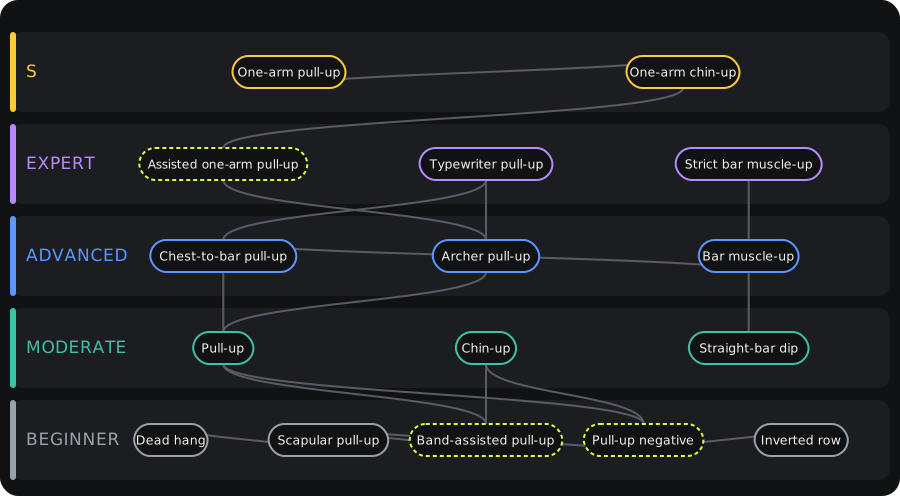
A calisthenics skill tree lays bodyweight moves out the way a game lays out skills: each move is a node, each node needs one or more easier moves first, and the branches climb from the first knee push-up to the planche and the one-arm pull-up. The Calisthenics Rep Counter skill tree has 203 moves in 16 families and five tiers, and every link in it is a real prerequisite.
How the calisthenics skill tree works
- Tiers. Beginner, Moderate, Advanced, Expert and S. A tier is a difficulty band, not a rank for the whole person: most people are Advanced on one family and Beginner on another, and the tree lets you be both.
- Prerequisites. A move opens when you reach the unlock standard on every move it needs. Most need one; the interesting ones need two from different families.
- Stripes. In the app each move has five stripes. Stripe three is the unlock standard, written on the move, such as 3 × 5 clean pull-ups or 3 × 20 s L-sit; stripes four and five are for owning it.
- Branches. A family splits into branches that train different things (strict reps, rings, one-arm work, explosive), so there is more than one next step.
Assisted steps are real nodes
The first rung has to be one you can do. 35 moves in the tree are assisted, using band, box, counterweight, feet, incline, jump, knee, negative help. They sit in the tree like any other move, with their own unlock standard, so a band pull-up or a knee push-up counts as progress: Wall push-up, Incline push-up, Knee push-up, Push-up negative (eccentric), Assisted one-arm push-up (incline / rolling), Wall HSPU negative, Feet-assisted dip, Band-assisted dip, Dip negative, Ring dip negative, Band-assisted pull-up, Jumping pull-up, Feet-assisted (box / low-ring) pull-up, Pull-up negative.
Where the branches meet
The hardest moves join two trees. That is why a skill tree beats a list: it tells you that a stuck muscle-up is often a dip problem, not a pull problem.
- Tiger-bend push-up (Advanced) needs Diamond push-up and Pike push-up.
- Wall HSPU negative (Advanced) needs Elevated (feet-on-box) pike push-up and Chest-to-wall handstand.
- Freestanding handstand push-up (Expert) needs Wall handstand push-up and Freestanding handstand.
- 90° push-up (S) needs Freestanding handstand push-up and Straddle planche.
- Tuck press to handstand (Expert) needs Freestanding handstand and L-sit.
- Straddle / pike press to handstand (Expert) needs Tuck press to handstand and Straddle L-sit.
- L-sit dip (Advanced) needs Parallel-bar dip and L-sit.
- Impossible dip (Expert) needs Parallel-bar dip and Tiger-bend push-up.
- L-sit pull-up (Advanced) needs Pull-up and L-sit.
- Tuck front lever row (Advanced) needs Tuck front lever and Inverted (Australian) row.
- Advanced tuck front lever row (Expert) needs Tuck front lever row and Advanced tuck front lever.
- Front lever row (S) needs Full front lever and Advanced tuck front lever row.
Every family and its branches
- Push-up — strict reps: Push-up → Diamond push-up → Decline (feet-elevated) push-up; rings: Ring push-up → RTO (rings turned out) push-up → Ring archer push-up; one arm: Archer push-up → Assisted one-arm push-up (incline / rolling) → One-arm push-up; planche prep: Pseudo-planche push-up → Tuck planche push-up; explosive: Clap push-up
- Handstand push-up — wall hspu: Pike push-up → Elevated (feet-on-box) pike push-up → Wall handstand push-up; deficit: Deficit (parallette) wall HSPU; freestanding: Freestanding handstand push-up → 90° push-up
- Handstand — wall: Wall plank / wall walk → Chest-to-wall handstand; freestanding: Handstand kick-up + bail → Freestanding handstand → Freestanding handstand 60 s; press: Straddle / pike press to handstand; one arm: One-arm handstand
- Dips — bars: Parallel-bar dip → L-sit dip → Korean dip; rings: Ring dip → RTO dip → Bulgarian ring dip; bar: Straight-bar dip; triceps: Impossible dip
- Pull-up — strict reps: Pull-up → Chest-to-bar pull-up → Weighted pull-up (+25% BW); muscle up: Chest-to-bar pull-up → Bar muscle-up; lever: L-sit pull-up → Tuck front lever; one arm: Archer pull-up → Typewriter pull-up → One-arm chin-up → One-arm pull-up
- Rows — two arm: Inverted (Australian) row → Ring row → Wide ring row; unilateral: Archer row → One-arm inverted row; lever: Tuck front lever row → Advanced tuck front lever row → Front lever row; isolation: Ring face pull → Reverse ring fly → Ring biceps curl
- Muscle-up — bar: Bar muscle-up → Strict bar muscle-up → L-sit muscle-up; rings: False-grip ring pull-up → Ring muscle-up
- Front lever — holds: Tuck front lever → Advanced tuck front lever → Straddle front lever → Full front lever; dynamic: Tuck front lever raise → Ice cream maker (tuck) → Front lever pull-up
- Back lever — mobility: German hang → Skin the cat; holds: Tuck back lever → Advanced tuck back lever → Straddle back lever → Full back lever
- Planche — balance: Crow pose → Frog stand; holds: Planche lean → Tuck planche → Advanced tuck planche → Straddle planche → Full planche; pushups: Tuck planche push-up → Straddle planche push-up → Full planche push-up; elbow lever: Elbow lever
- L-sit / V-sit — l sit: Tuck L-sit → L-sit → Ring L-sit; straddle: Straddle L-sit; v sit: V-sit (45°->90°) → Manna
- Human flag — holds: Tuck human flag → Straddle human flag → Full human flag
- Core — anti extension: Plank → Hollow body hold → Kneeling ab-wheel / ring rollout → Standing ab-wheel rollout; hanging: Hanging knee raise → Hanging leg raise → Toes-to-bar (strict) → Hanging windshield wiper; dragon flag: Tuck dragon flag → Dragon flag negative → Dragon flag; anti rotation: Side plank → Band Pallof press; extension: Reverse hyperextension → Arch body hold (superman)
- Legs — squat: Bodyweight (full) squat → Split squat → Bulgarian split squat; pistol: Assisted pistol (holding post / ring) → Box pistol (to bench) → Pistol squat; shrimp: Beginner shrimp squat (knee to pad) → Shrimp squat; knee dominant: Sissy squat (free); hinge: Glute bridge → Single-leg Romanian deadlift → Nordic curl (full); calves: Calf raise → Single-leg calf raise (deficit)
- Bridge — bridge: Reverse plank → Tabletop bridge → Angled (elevated) bridge → Full bridge (wheel); one limb: One-leg bridge
- Rings strength — straight arm: Ring chest fly → Band-assisted iron cross / cross pulley → Iron cross; maltese: Maltese (ring height planche); inverted: Inverted cross
The full list with every unlock standard is the calisthenics progression chart; one skill worked through step by step is the front lever progression.
Climb it with Calisthenics Rep Counter. Calisthenics Rep Counter is a push up counter app with this whole tree inside: prop the phone and the camera counts the moves it can read and times holds in form, every set goes into your log, and stripe three on each move unlocks the next. Logging and the whole tree are free forever.
Get it on Google Play About Calisthenics Rep CounterQuestions
What is a calisthenics skill tree?
A map of bodyweight moves where each move needs one or more easier moves first, grouped into families and tiers, so you can see every path from where you are to a skill like the planche or the one-arm pull-up.
Is a skill tree better than a workout program?
They do different jobs. A program tells you what to do today; the tree tells you what you are working toward and what is holding you back. Many people follow a simple routine and use the tree to pick its exercises.
What are the calisthenics tiers?
Beginner (the first months), Moderate (months 3 to 12: first pull-ups, dips, L-sit, tuck front lever), Advanced (year 1 to 2: muscle-up, pistol, back lever, wall handstand push-up), Expert (year 2 to 4: full front lever, straddle planche, human flag) and S (elite strength such as the full planche and one-arm pull-up).
Can I be at different levels in different skills?
Yes, and nearly everyone is. The tree tracks each move on its own, so you can be Advanced on push-ups and Beginner on the handstand without one holding the other back.